
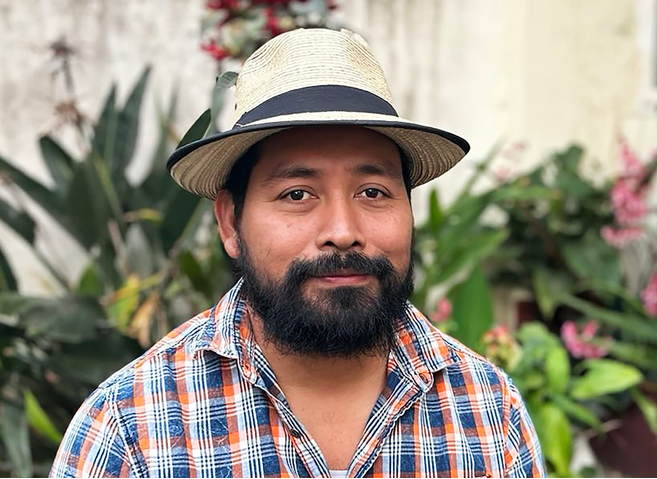
Roman Gressier interviewed journalist Carlos Choc about his criminalisation by the state and the continuing struggle against rapacious resource extraction companies stirrping Guatemala of its wealth. Carlos Choc is Maya Q’eqchi’ and a high-profile practitioner of periodismo comunitario (community journalism)’. The interview was carried by El Faro English.
“I’m a journalist, not a criminal.” Those were among the first words from Q’eqchi’ Mayan journalist Carlos Choc when we met in Guatemala City for this interview. Intimidation, raids of his home, and legal persecution with the threat of prison time have hung over his head like a sword of Damocles since 2017. At the end of January, a judge finally dismissed complaints of illicit association, threats, and instigation of crime filed against him by the Guatemalan Nickel Company (CGN), subsidiary of the Swiss firm Solway Investment Group, in retaliation for a decade of reporting for news outlets such as Prensa Comunitaria from El Estor, Izabal, on the operations of the mine. Choc was never arrested, but a judge ordered him to report to the Public Prosecutor’s Office every month for the last six years.
“I proved my innocence to the justice system and to a Public Prosecutor’s Office that first accuses you and only then investigates,” he says.
Even so, Choc does not rule out the possibility that Attorney General Consuelo Porras, a symbol of the judicial corruption that has roiled Guatemala in recent years, could open a new investigation into him. For his security, he still lives displaced from his hometown, in a place he does not risk revealing.
A high-profile practitioner of periodismo comunitario in Guatemala —community journalism, produced in this case by Indigenous journalists for and from their communities—, Choc is also the face of Mining Secrets, an investigation published in March 2022 by 17 news outlets on three continents that analyzed leaked documents from CGN, confirmed the mine’s environmental contamination, and revealed the cooptation of the Guatemalan state and intimidation of critics. The U.S. Treasury reacted the following December by placing Magnitsky sanctions on the company, but dropped them five months later. Guatemalan authorities have not opened a formal investigation against the firm.
Last year, while Indigenous movements defended the electoral results in the streets, the winner, Bernardo Arévalo, promised them a moratorium on mining. Since the change of government in January, Choc acknowledges that “there are spaces” where the administration do listen to Indigenous leaders, but he doubts that the president will keep that commitment. “It will be difficult for Arévalo to respect the rights of the [Indigenous] peoples, because there are mining contracts that were already granted,” he says.
He believes that the economic crisis and persecution in Q’eqchi’ territory will continue to advance hand-in-hand with agro-industry: “The Q’eqchi’ people are being dispossessed and expelled from their lands, and what is left is to migrate [to the United States],” he laments.
You can read the full piece, with photos and links, here, “Despite the new government, the advance of mining in Guatemala is already decided”.
Categories: Corruption, Criminalisation, Environment, Guatemala, Human Rights, Impunity, Indigenous peoples, Justice, Land, Mining, Resource Extraction, Solidarity in Action, Solidarity in Action/Guatemala, Violence
 Guatemala Solidarity Network
Post comments here